GhostHunters
Game Designer & UX Researcher
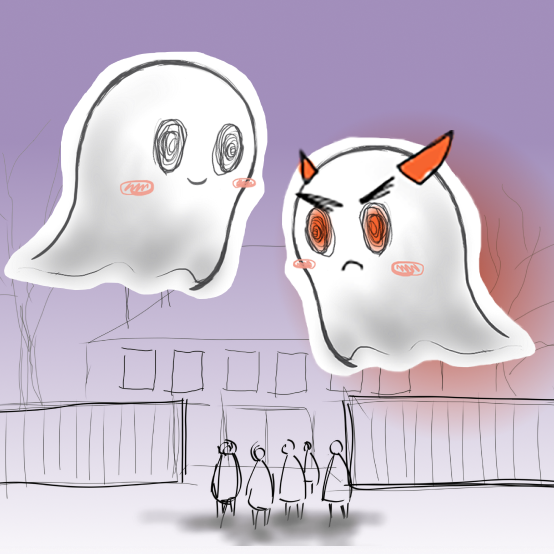
During the Persuasive Design course of my HCI Master’s program, my team conducted research and designed a game to combat the spread of misinformation. GhostHunters is a mobile game aimed at bettering players' understanding of the tactics often used to create fake news and proactively engage players to help them more critically evaluate the information they might share online.
Course
Persuasive Design (Instructed by Dr. Geoff Kaufman)
Team
Aziz Ghadiali • Brady Baldwin • Cidney Vinceta • Meo Zheng • Raajat Gupta
Duration
Fall 2020
Project Background & Goals
At the beginning of the semester, our team was tasked with designing a persuasive intervention centered around the idea of fake news. We started the project by creating mind maps around the topic of fake news and decided as a team to move forward with an intervention in the form of a digital game.
Generative Research Goals
- Better understand the tactics employed to create and spread misinformation online.
- Learn the ways that people typically engage with news they encounter online and observe their sharing habits.
- Explore persuasive methods in game design and critically examine how they might be apllied to our game.
Design Research Goals
- Experiment with gameplay to learn how we can best motivate players to better identify fake news.
- Bring attention to the most common elements and aspects of fake news to help players better evaluate the credibility of news they encounter online.
- Make the game enjoyable and repayable.
Research Methods
Literature Review
- We started this project by first learning more about fake news and the social psychological factors that contribute into its' influence.
- Much of our early literature review was also focused on persuasive methods of design and, more specifically, methods employed in game design. We also took this time to see how other games had employed persuasive methods to create fun and compelling gameplay.
Contextual Inquiry
- After learning more around the topic of fake news, we designed a remote contextual inquiry study that simulated fake (and credible) news that people might encounter on Facebook.
- After seeing a news article on the Facebook feed we created, participants were asked to rate the credibility of the article on several factors.
- For our rating system, we created a scale for users to rate credibility on the basis of domain/URL credibility, accuracy of headline, accuracy of facts, relevance of source/quotes used, and relevance of images.
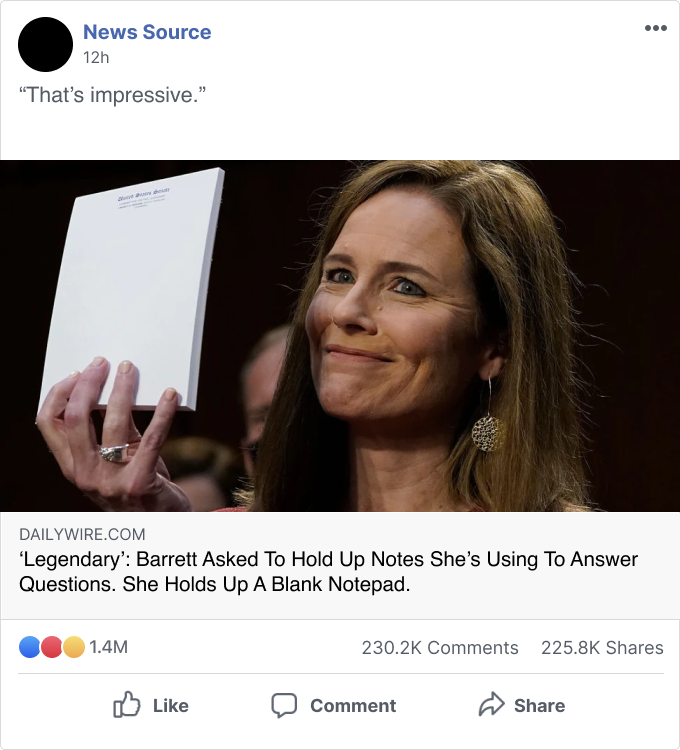
Example news article we created for our Facebook feed.
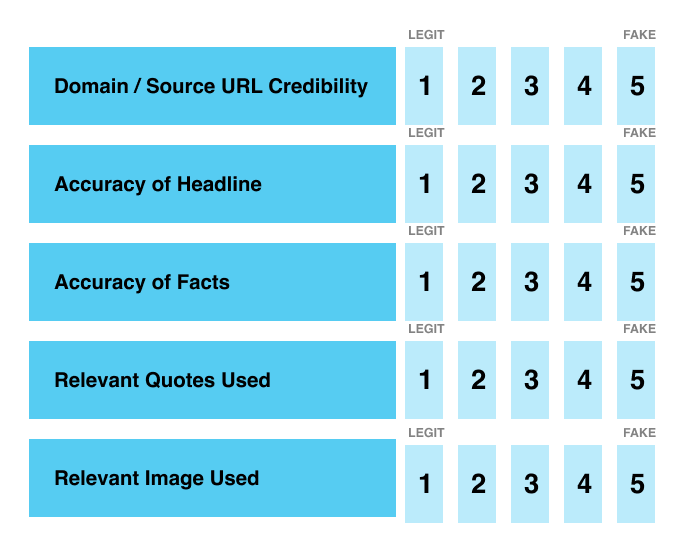
Scale used for participants' to score perceived "fakeness" of articles.
Parallel Prototyping
- Once we learned more about how people engage with news online and the methods they use to determine the credibility of news, we started sketching low-fidelity ideas of our game. We all started on the premise that we wanted to employ three key principles in the design of our game. We wanted our game to be set in a fictional universe to obfuscate the real goal of our design, we wanted to incentivize behaviors that are positive to identifying fake news, and we wanted to make critical thinking a core dynamic of gameplay through collaboration with other players.
- After creating several low-fidelity prototypes of our ideas, we tested them with users to get a better of sense of which ideas were working the best across a spectrum of factors.
- From this round of testing, we landed on the genre of social deduction (popular game examples included Among Us, Secret Hitler) and the theme of a haunted house.
Playtesting
- Once we had taken strong elements from all of the early prototypes, we worked as a team to design a game that encompassed our key principles and created a compelling experience for players.
- We went through several rounds of playtesting and iterations on the game to tweak game mechanics to make the game more fun and increase replay-ability.
- Early in our testing, we had identified that players were having a hard time remembering the rules and enjoying the first round of gameplay. It was at this point that I contributed the idea of an interactive tutorial to introduce the key gameplay mechanics and build around the universe in which GhostHunters takes place.
Final Game Prototype
GhostHunters is a social deduction game that educates players on tactics used to generate fake news and equips them with the knowledge to better identify it. In GhostHunters, players are thrown into a haunted house and tasked with exorcising a demon spirit that lingers in the house. One player is assigned the Demon role and their goal is to avoid being exorcised. The other players are Ghost Hunters and their goal is to gather evidence that will help them exorcise the demon and save their fellow party member.
Ghost Hunter Gameplay
- Ghost Hunters' goal is to find evidence to figure out the ritual needed to exorcise the Demon.
- They are assisted by Juju (our friendly ghost) to critically evaluate the articles of information spread throughout the haunted house. For each article of information, players can ask Juju about one aspect of its credibility. Players can inquire about the author, content, or publishing source. Players can also mark articles as fake.
- At the end of every round, each Ghost Hunter must bring a piece of evidence to attempt to exorcise the demon. Players are given a brief period of time to discuss their evidence and, at this time, it can be seen whether an article was marked by other players as fake. All players must then vote to discard a piece of evidence. If more than two of the articles that remain are fake, the ghost hunters lose.
Demon Gameplay
- The Demon's goal is to find accurate evidence and manipulate aspects of it to make it appear fake.
- Similar to the Ghost Hunters, the Demon is assisted by Zuzu (our evil ghost) in manipulating elements of articles and disrupting the Ghost Hunters' gameplay.
What I learned
- This project (and course) were my first introduction to persuasive design. GhostHunters provided an excellent outlet to learn and apply persuasive methods of design in a fun, interactive, way that allowed me to directly see the implications of the design patterns.
- As my largest group project, I learned effective ways to collarborate across a larger team and organize/document information in a way that promoted healthy collaboration.
- This project taught me a great deal around intermixing common practices from UX and Game Design to create an educational (and fun!) experience. With a long-held passion for games, it was really eye-opening seeing the overlap between the two design practices and, to a greater extent, seeing how they can be used in combination to create rich experiences for users.
For more details about this project, please reach out directly to zachvancleef.ux@gmail.com